

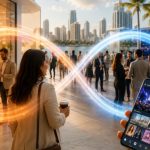
As you may have seen, most movies set in futuristic scenarios are characterized by the presence of 3D elements, touch screens in the air, and interactions with machines or robots, and although we may see it as something far away, the reality is that we are much closer than we think, thanks to technologies such as Extended Reality.
Extended reality (XR) is one that combines virtual reality (VR), augmented reality (AR) and mixed reality (MR) in the same environment. The first of these technologies (VR) can take the user into a 360-degree computer-simulated virtual reality environment, and although this is the best known form of XR technology, it is only the 38% of international virtual marketplaces.
The other 62% is composed of augmented reality that can assume computer-generated graphics in the real world: and mixed reality that can merge the virtual world and the live real world. This allows both environments to coexist and interact in real time.
Although extended reality is a relatively new technology, it is rapidly reaching industries offering unimaginable user experiences. Indeed, XR is already beginning to be employed by some sectors, and by 2022 its use is expected to increase 8-fold, reaching a market size of $209 billion.
These projections only confirm the need for companies to look for more effective alternatives to strengthen the relationship between brands and their customers. Those of us who work in the world of marketing and advertising know that the modern consumer is in constant search of experiences and the better the experiences, the more opportunities we will have to position our brand in the top of mind of the customer, so why not start exploring these technological alternatives that break with all the traditional schemes?
I would dare to say that companies that begin to direct their strategies towards cooperative digital experiences are preparing for a successful future, because although omnichannel demands a great responsibility in personalization and information management, these will be the new ways of selling products or services in the medium term, in which it will no longer be necessary to go to a store to buy a new sofa and wait for its arrival to see if it really combines with your living room; now with extended reality, just by entering an App, you can see how that sofa looks, make the purchase and receive it at home.
Immersive experiences in mixed scenarios
Offering experiences in mixed scenarios where the physical world is mixed with extended realities, enables infinite possibilities for business marketing, as this immersive interaction environment manages to enhance the visual, auditory and olfactory experience, generating greater impact on our target.
No matter what sector you are in, all businesses will have to bet on this type of hybrid scenarios, as it is estimated that by the end of this year, 3.4 billion phones will have even more advanced augmented reality capabilities, which means that millions of buyers will be able to approach physical products with digitally integrated content, making their purchases more informed; and if these will be the forms of commercial interaction of the near future, where your consumer is, your brand must also be.
I invite you to bet on innovation through extended technologies that will allow you to improve productivity, overcome time and space barriers, increase your company's exposure and exceed consumers' expectations in their future experiences.
Never forget that innovation is what every evolving company needs.
Don't be left behind!




 Spanish
 English