

Have you noticed the trend on social media saying “2026 is the new 2016”?
It’s not a coincidence. The world is experiencing a wave of nostalgia; a desire to reconnect with what felt simpler, more authentic, and more human. People aren’t just looking back at the past for aesthetics; they’re longing for real connection again.
There is a growing cultural shift toward rediscovering and valuing what once felt genuine. And Forrester has been giving very clear signals: in its predictions for 2026, it suggests that one-third of consumers will prefer offline experiences over online ones, and that 52% of online adults in the U.S. are actively seeking in-person and tactile experiences.
From reactive experiences to continuous ecosystems
I’ve seen brands do incredible activations… and then disappear. Like fireworks: they shine, excite, get shared… and the next day, nothing remains.
That’s what I call reactive experiences isolated actions that depend on the calendar, the budget, or the latest viral moment.
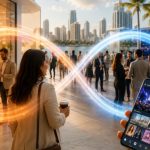
But the brands that will truly compete in 2026 will operate under a different logic: continuous experiential ecosystems. A living system that creates interaction before, during, and after the experience. A system that turns the relationship with the consumer into an ongoing habit.
Trend 1: Hybrid, but truly hybrid
True hybrid experiences are designed as two parallel presences physical and digital each offering its own value, yet connected through the same emotional narrative.
The real question brands should ask is:
What part of this experience should be felt physically… and what part can be scaled through technology without losing its humanity?
Even as early as 2022, Forrester reported that 58% of surveyed leaders expected flagship B2B events to become hybrid within two years.
For me, hybrid represents an opportunity to stay connected with audiences across multiple moments, channels, and timelines far beyond a single event.
Trend 2: Immersive retail as an emotional (and data) platform
By 2026, retail can no longer function as just a point of sale.
It must become a point of connection.
A clear example is Nike Rise a store concept designed to be locally rooted, culturally connected to its city, and digitally integrated.
Interactive tools like RFID tables and real-time content signals transform the visit from a simple shopping trip into an experience of participation.
In 2026, the most successful retail spaces won’t be the ones with the most screens. They’ll be the ones that turn the store into a stage where people actively engage.
Trend 3: Leave the human part to humans
AI will be everywhere that’s already inevitable.
The real risk now is using it purely as a cost-cutting tool and paying for it with the most expensive currency of all: trust.
Forrester warns that by 2026 one-third of companies may damage customer experience due to frustration with poorly implemented AI self-service systems, ultimately eroding brand trust and harming both acquisition and retention.
A simple rule for 2026 might be:
- AI for friction: solve repetitive problems quickly.
- Humans for meaning: handle sensitive moments, important decisions, and rebuilding trust.
Learning to Compete in 2026
For me, the competitive advantage of the future can be summarized simply:
- The brands that integrate emotion, data, and creativity will dominate.
- Emotion without data can be inspiring, but unsustainable.
- Data without emotion can be efficient, but forgettable.
- Creativity without a system can be brilliant, but inconsistent.
If 2026 truly becomes the year when experience turns into economic value, success won’t come from saying more. It will come from making people feel something meaningful consistently.
And that leads to one final question:
Could your brand survive today through an experiential ecosystem that connects with consumers every day?




 Spanish
 English