
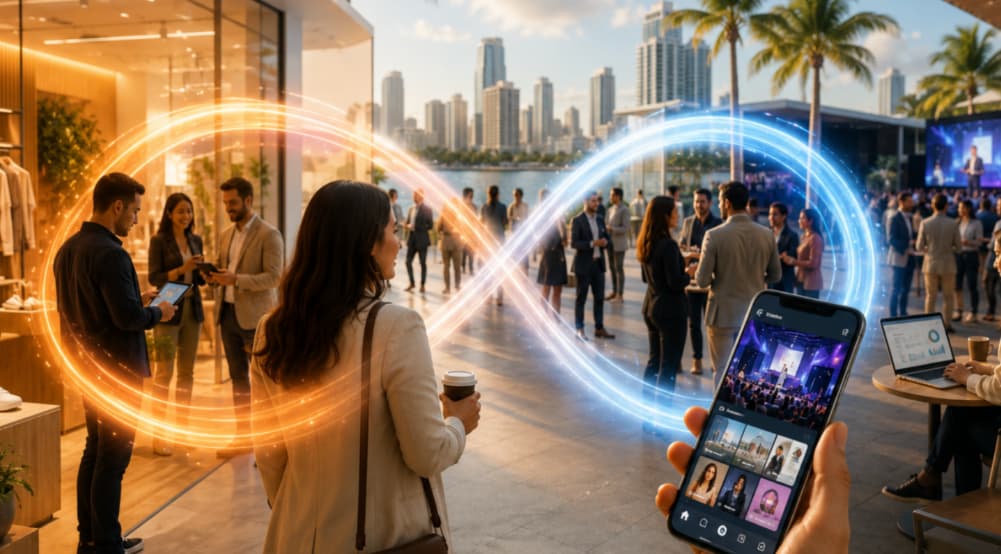
For years we've talked about the convergence of physical and digital as an emerging trend. By 2026, that conversation has already changed.
The question is no longer whether an experience should be physical or digital. The question is whether both dimensions are intentionally designed to work as a connected system.
I continue to observe organizations investing significant resources in memorable events, immersive activations, and attractive physical environments. However, those building a lasting competitive advantage are not necessarily the ones producing the most impressive event. They are the ones ensuring the experience continues after the event ends.
Physical experiences returned. But they didn't return alone.
They return to communities, content, data, personalization, technology, and ongoing relationships that extend the value of each interaction. That’s where the true consolidation of phygital experiences begins.
From isolated events to continuous ecosystems
For years, brands focused on designing moments: a conference, a launch, a trade show, an activation. Success was measured by attendance, reach, or engagement.
Today's leading organizations ask a different question. Instead of asking how to bring people to an event, they ask how to create a relationship that begins before the in-person encounter and continues long after it ends.
The difference may seem subtle, but it fundamentally changes the strategy.
An event generates attention. An ecosystem builds memory. And memory is one of the most valuable assets a brand can build.
Behavioral science has consistently shown that people don't remember every moment of an experience. They remember the significant moments, the emotional peaks, and how an experience concludes. When brands intentionally extend those emotional connections over time, they increase the likelihood of remaining relevant in people's minds.
For Trade Marketing and Brand teams designing activations in multiple LATAM markets, this has a direct implication: the budget invested in an event without a continuity mechanism is, by definition, a one-time expense. One that does have it is an investment in community.
Experiential retail: when the store becomes a relationship
One of the clearest examples of this evolution can be found in experiential retail. For decades, the store represented the final step in the customer journey.
Today, the most innovative retailers are redesigning that model. By integrating mobile apps, loyalty programs, personalized content, real-time inventory visibility, and in-store experiences into a single, connected journey, they're turning the store into a touchpoint within a broader relationship.
An in-store visit is no longer a one-off transaction. It has become another chapter in an ongoing experience that began before the purchase and continues after it. The result isn't just higher conversion rates—it's a deeper, more meaningful connection that competitors are finding increasingly difficult to replicate.
Sports Promotions: When the Game Is Just the Beginning
Sports offer another powerful example of where the industry is headed. Traditionally, a brand activation would happen around a specific game or tournament. The brand would be present during the event and disappear once it was over.
Today, leading organizations operate differently. They engage audiences before the event through digital platforms, create personalized content, encourage participation during the event, and continue the conversation afterward.
The match is still important, but it's no longer the complete experience.
The experience can last weeks, months, or even years. Each interaction reinforces the emotional memory associated with the brand and strengthens the sense of belonging that communities increasingly value.
Miami: A laboratory for mature hybrid experiences
I see the same evolution in many corporate events taking place in Miami. For years, conferences relied almost entirely on what happened during the days attendees were physically present.
Today, the most successful events are designed differently. They build communities before the event, facilitate meaningful connections through digital platforms, deliver exclusive content during the experience, and maintain engagement long after attendees return home.
The event itself is no longer the product. It becomes the visible meeting place for an ongoing community. And that radically changes the value people perceive—because the relationship continues to create relevance beyond the event dates.
The future doesn't belong to immersive experiences. It belongs to continuous experiences.
Many people believe that the future belongs to immersive experiences. I believe the opportunity is even greater.
The future belongs to continuous experiences.
People can forget an extraordinary activation. They can forget a remarkable conference. They can even forget a significant purchase. What is much harder to forget is a relationship that consistently creates meaning over time.
That's where emotion becomes memory. And where memory becomes competitive advantage.
When brands connect physical and digital touchpoints with intention and consistency, they stop managing isolated moments and start building lasting relationships.
As we move into 2026, the most important question isn't how many events we're creating.
The question is much more strategic:
Are we designing experiences that end when people leave, or ecosystems that remain present when they return to their daily lives?



 Spanish
 English